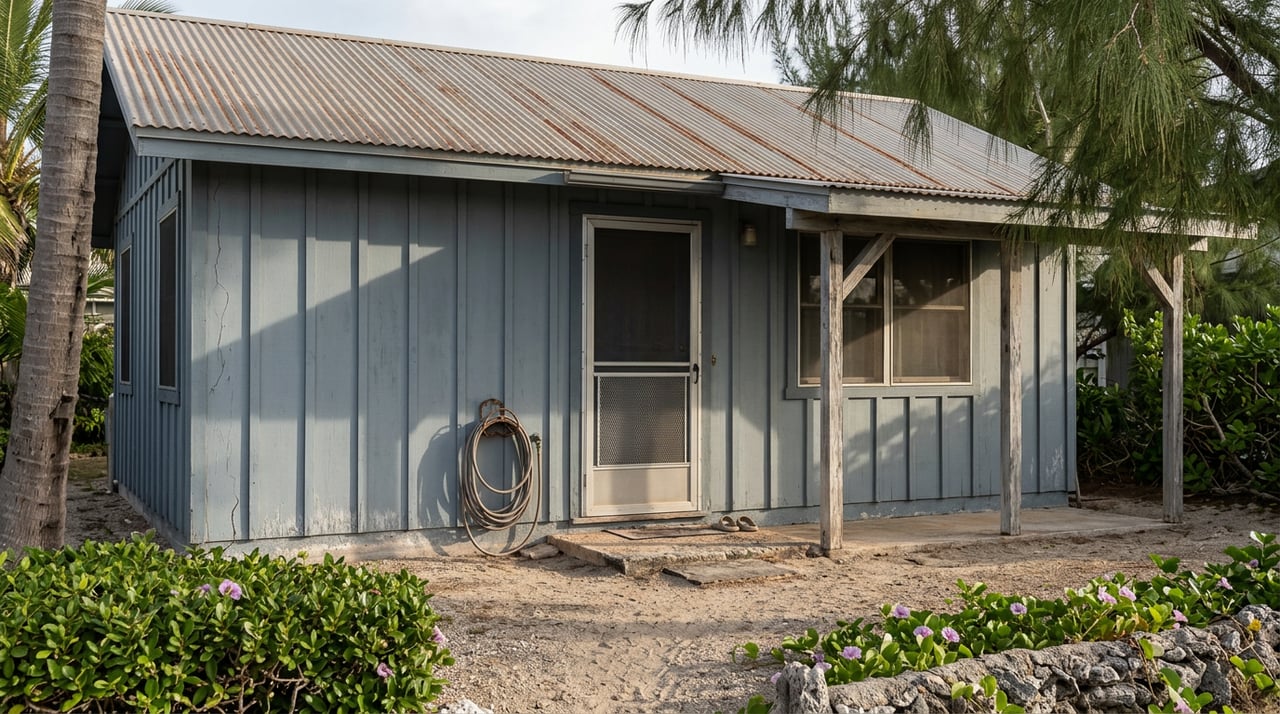
Drive the two and a half miles of Puako Beach Drive and you will not find a gatehouse, a design review board, or a mandatory monthly assessment. The Puako Community Association survives on $25 a year in voluntary dues, mailed to a PO Box in Kamuela, and its stated mission is as plain as its budget: protect the quality of life in Puako at a personal, community, and legislative level. No rulebook. No fines. Just neighbors who choose to chip in.
So it is worth sitting with the fact that this same lightly governed stretch of coastline is, according to Hawaii County's own mayor, the most organized community on the island when it comes to solving one of its hardest infrastructure problems. Somewhere between the absence of enforced rules and the presence of real results, there is a story about how Puako actually works.
What's Under the Water
The reason any of this matters starts offshore. Coral cover along the Puako reef has fallen from roughly three quarters of the shoreline fifty years ago to less than one tenth today, a decline researchers have traced back to cesspools and inadequate septic systems leaching nitrogen into the nearshore water. Hawaii's volcanic geology does the reef no favors here. Dye tracing studies placed in residential wastewater systems along Puako Beach Drive showed effluent reaching the shoreline in as little as five hours, a finding that first came into focus through a 2013 Cornell study and follow-up work by The Nature Conservancy and the University of Hawaii at Hilo.
That is the kind of number that changes how residents think about a faucet. The water still runs clear. The ocean still looks the way it always has from the road. But the coral telling a different story below the surface is why a volunteer group called Puakō For Reefs has spent more than a decade, and more than $3.5 million raised from neighbors and outside supporters, trying to fix the actual source of the problem rather than manage its symptoms.
The Math That Changed the County's Mind
For years, the obstacle wasn't willingness. It was money and geology. A conventional gravity sewer, the kind most municipalities use, requires large underground pipes, in some cases up to 60 inches wide, buried deep enough to let waste flow downhill to a treatment plant. In Puako's lava rock, digging that deep is both impractical and enormously expensive. Karen Anderson, president of Puakō For Reefs, has put a figure on the gap: a traditional gravity system was projected at roughly $120 million, against about $12 million for a low-pressure alternative that grinds waste and pumps it through smaller pipes instead of relying on gravity.
That ten-to-one difference is likely why Hawaii County Mayor Kimo Alameda, who as recently as last fall expressed skepticism about a sewer project in Puako, has since come around. Facing a state mandate to convert more than 49,000 cesspools islandwide by 2050, a target he has called effectively impossible, the county needed a workable template somewhere. Puako offered one already in motion. "This is the most organized community right now," Alameda told Honolulu Civil Beat this summer. "They have a plan."
The plan, as it stands: a low-pressure system serving around 200 homes, routing wastewater to the American Water Plant in neighboring Mauna Lani resort rather than requiring the county to build new treatment capacity from scratch. Puakō For Reefs recently held a kickoff design meeting with the county's Department of Environmental Management, with hopes of finishing planning and permitting by the end of 2027 and breaking ground in 2028.
A few numbers worth holding onto if you live along that stretch of coast:
- Roughly 200 homes are expected to connect to the new system
- Estimated construction cost runs $12 million to $20 million, not the $120 million a gravity system would have required
- Individual homeowners are looking at an estimated $40,000 to connect a property currently on a cesspool
- The target timeline points to permitting wrapped by late 2027 and construction starting in 2028
None of that is free, and no one involved has pretended otherwise. But it is a real number, attached to a real design, which is more than most of the 49,000 cesspool households on the island can currently say about their own path forward.
More Bids Than Anyone Expected
Rick Gaffney, a former member of the county's Environmental Management Commission, now runs a monthly community working group that keeps this project in front of county officials. What he points to as unusual isn't just persistence. It's procurement. Most wastewater infrastructure in Hawaii ends up handled by two or three large firms because that's simply how the industry works. Puakō For Reefs took a different approach and reached out to 98 different contractors for pre-bids, on the theory that more bidders produce more realistic pricing.
That single decision says something about the difference between a community acting because it has to and one acting because it wants to. A mandatory HOA can compel a homeowner to repaint a fence. It cannot easily produce the kind of grassroots persistence that gets 98 contractors to the table for a project with no guaranteed funding behind it.
Learning From a Community That's Already Done This
Puako hasn't tried to solve this in isolation. The same low-pressure technology under consideration, built by Orenco Systems, has already been installed in Vero Beach, Florida, where officials dealt with a strikingly similar problem: failing septic systems degrading a coastal lagoon. Robert Bolton, who led that implementation for Vero Beach County, and Mike Saunders of Orenco Systems have visited Puako to walk residents through what installation, operations, and long-term maintenance actually look like once the pipes are in the ground. That is a level of due diligence a top-down county project rarely bothers with before construction starts.
The state has taken notice too. Both chambers of the Hawaii State Legislature passed a concurrent resolution encouraging Hawaii County, the Department of Health, and the University of Hawaii at Hilo to work together to complete the Puako sewer project. The county's own Puakō coastline sits on a list of 14 priority sites statewide identified for cesspool conversion, and Puakō For Reefs has said its findings are meant to be shared with 26 other coastal communities facing the same wastewater and reef problem.
What This Actually Means If You Live Here
None of this changes what a morning at Paniau Beach or a snorkel session off Puako Bay looks like today. The reef isn't restored yet. Construction hasn't started. What has changed is the shape of the path to get there, and who is actually driving it. A neighborhood with no mandatory HOA, no enforced covenants, and a $25 suggested donation has out-organized a county process on one of the most technically difficult infrastructure problems on the island, largely because residents treated the reef as something worth their own time and money before anyone required it of them.
That is a different story than the one usually told about Puako, which tends to stop at tide pools and petroglyphs and old Hawaii charm. The charm is real. So is the fact that the people who live along that quiet road have spent more than a decade proving that voluntary civic effort can outpace mandate. If you're already part of this community, that's worth knowing next time you're standing in the water wondering what's happening beneath it.
If you have questions about property along Puako Beach Drive, how the sewer project might affect a specific parcel, or what else is changing along this stretch of the Kohala Coast, Schenk Properties has spent decades working this coastline and is glad to talk through what we know.